

Table of Contents
ToggleCherry wood brings a richness to bedroom spaces that few other materials can match. Its warm reddish-brown tones deepen beautifully over time, creating furniture that becomes more striking with age. Whether someone’s furnishing a master suite or a guest room, cherry bedroom furniture offers durability, classic appeal, and the kind of craftsmanship that holds up through decades of use. This guide walks through everything needed to choose, care for, and design around cherry pieces, from understanding what makes the wood special to deciding between solid and veneered options.
Key Takeaways
- Cherry bedroom furniture develops a beautiful reddish-brown patina over time, making it an investment that grows more striking with age and deepens in value for classic or transitional bedroom designs.
- The Janka hardness rating of 950 makes cherry wood ideal for bedroom use—soft enough for detailed joinery like dovetails and turned posts, yet durable enough to resist everyday dents and scratches.
- Maintain cherry bedroom furniture with weekly microfiber dusting, quarterly wax applications, and humidity control between 40–50% to prevent drawer sticking and joint separation in changing seasons.
- Solid cherry furniture justifies its $1,200–$4,000 price tag for high-use pieces and heirloom-quality designs, while quality veneered cherry offers cost-effective alternatives for larger case pieces that won’t be refinished.
- Pair cherry bedroom furniture with greige, soft gray, or sage-green walls and warm LED lighting (2700–3000K) to showcase the wood’s natural color while avoiding warm wall tones that make spaces feel smaller.
- Light oak or whitewashed hardwood flooring with contrasting area rugs, combined with metal accents and glass elements, prevents cherry furniture from feeling visually heavy and maintains modern balance in traditional spaces.
What Makes Cherry Wood Ideal for Bedroom Furniture
Cherry wood (specifically American black cherry, Prunus serotina) stands out for its fine, straight grain and exceptional workability. It machines cleanly, takes stain well, though most craftsmen prefer clear finishes to showcase the natural color, and develops a patina that darkens from pale pinkish-tan to deep reddish-brown over years of exposure to light.
The hardness rating sits at 950 on the Janka scale, making it softer than oak or maple but harder than pine or poplar. This means it resists everyday dents and scratches in bedroom use (where impact is minimal) while remaining easy to work with hand tools or routers for detailed joinery. Furniture makers favor it for intricate designs: raised panels, turned posts, and dovetailed drawers all benefit from cherry’s stability.
Cherry has a specific gravity of 0.50 (at 12% moisture content), which translates to moderate weight, heavier than pine, lighter than walnut. A solid cherry dresser won’t tip easily but can still be moved by one person with a furniture dolly. The wood’s low shrinkage rate (about 3.7% radial, 7.1% tangential) means properly dried cherry stays flat and resists warping in climate-controlled bedrooms.
One distinct characteristic: cherry exhibits gum pockets, small resin deposits that appear as dark streaks. High-grade furniture uses boards with minimal figuring, but some buyers appreciate the character marks. The sapwood (outer growth) is pale cream and usually excluded from premium pieces: heartwood (center growth) provides the signature color.
Popular Cherry Bedroom Furniture Styles and Designs
Cherry adapts to nearly every design era, but it shines brightest in traditional and transitional settings.
Traditional and Classic Cherry Bedroom Sets
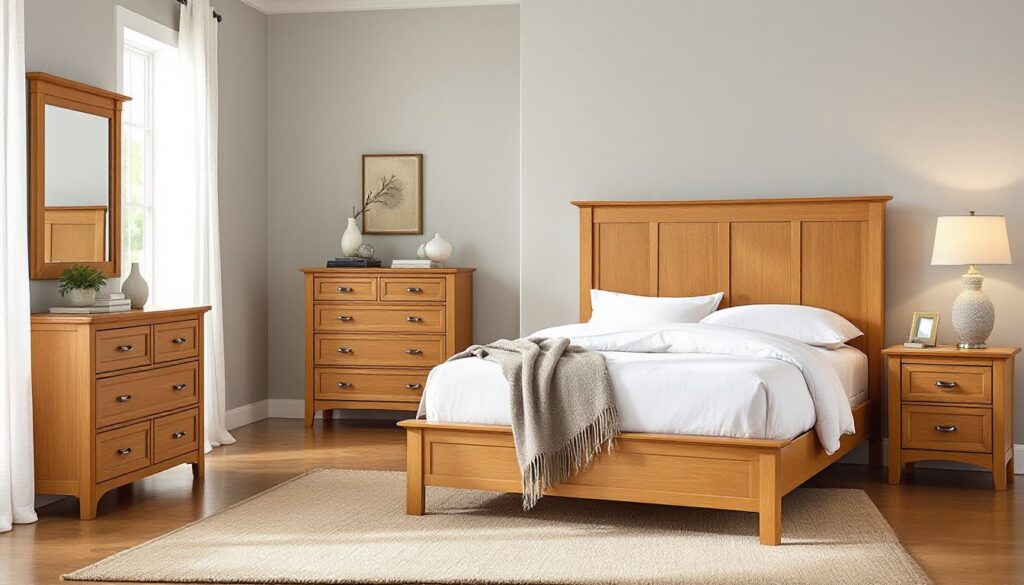
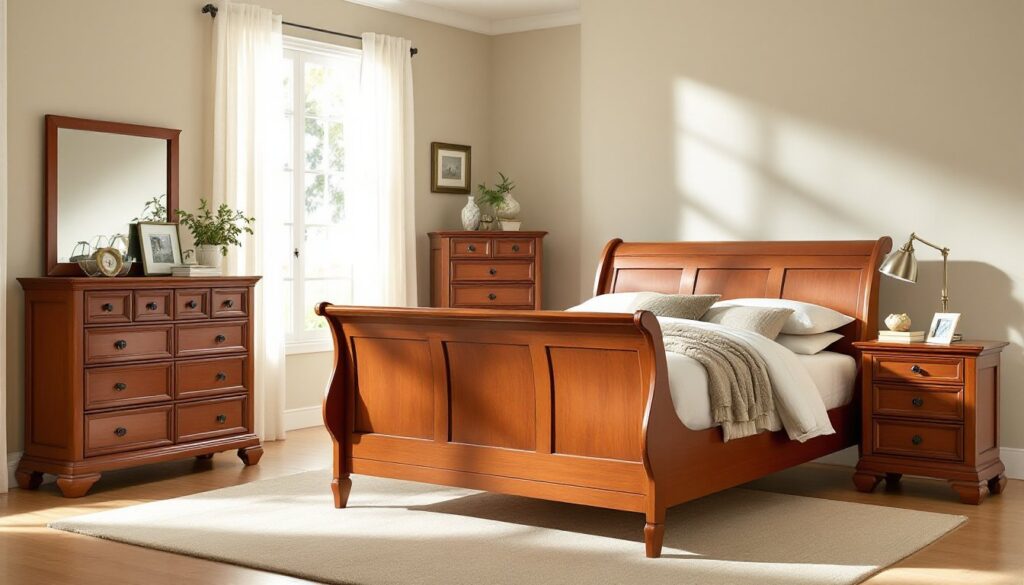
Sleigh beds remain the hallmark of traditional cherry furniture. The curved headboard and footboard, typically 50–60 inches wide for a queen, show off cherry’s grain pattern and color depth. Look for mortise-and-tenon joinery at stress points (where rails meet posts) and solid-wood slats rather than metal frames.
Panel beds feature flat or raised panels set into frames, often with crown molding at the headboard’s top edge. Craftsmen rout the panels from single boards to display continuous grain. Quality traditional sets include matching case pieces: a six-drawer dresser (usually 60–66 inches wide), a five-drawer chest (taller, narrower profile), and nightstands with dovetailed drawers and full-extension glides.
Many classic designs incorporate bun feet or turned legs, carved details on drawer fronts, and brass or antique bronze hardware. The finish is typically satin or semi-gloss lacquer over bare wood, no stain, allowing the natural aging process to dominate. Colonial, Federal, and Shaker influences show up in proportions: Shaker pieces emphasize clean lines and minimal ornamentation, while Federal styles add inlays or reeded columns.
Modern and Contemporary Cherry Furniture Options
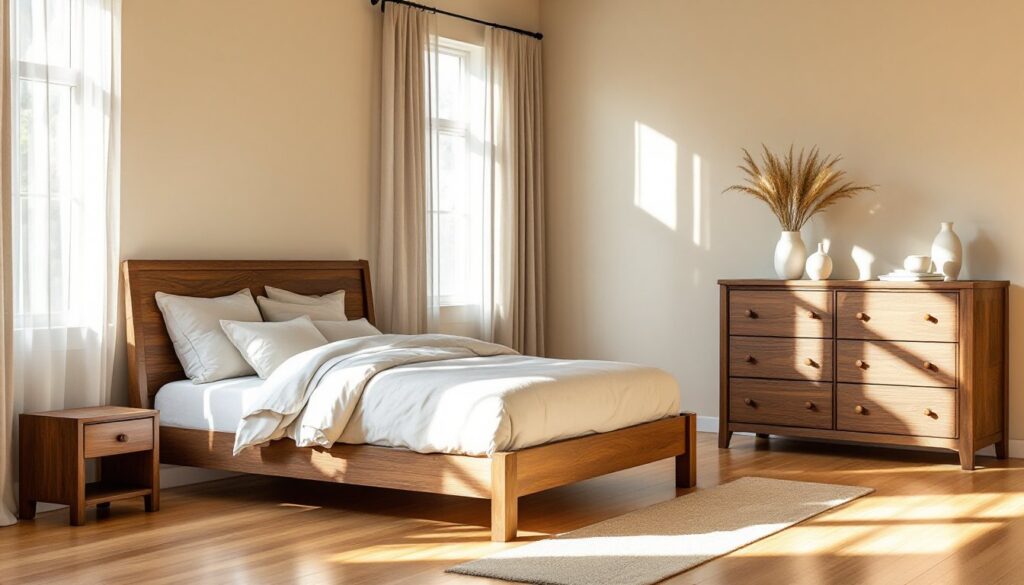
Platform beds in cherry strip away traditional details. The headboard might be a simple floating panel, and the frame sits low (10–12 inches off the floor) with a solid base eliminating the need for a box spring. Edges stay sharp, hardware recesses into the wood, and finishes lean toward matte or natural oil rather than glossy lacquer.
Contemporary bedroom design approaches often pair cherry with contrasting materials: walnut accents, brushed steel drawer pulls, or glass-topped dressers with cherry frames. Waterfall edges, where the grain wraps continuously over a corner, showcase bookmatched veneers. Some makers use live-edge slabs for headboards, preserving the bark edge and natural contours.
Floating nightstands (wall-mounted with concealed brackets) and low-profile dressers (36 inches wide instead of the traditional 60) suit smaller bedrooms. Drawer fronts might be touch-latch or push-to-open, eliminating visible hardware entirely. The key: contemporary cherry furniture emphasizes the wood’s color and grain as the focal point, not applied decoration.
How to Care for and Maintain Cherry Bedroom Furniture
Cherry’s beauty depends on consistent, minimal maintenance. The wood darkens naturally through UV exposure, but uneven light causes blotchy aging, rotate decorative items on dresser tops every few months to prevent shadowed outlines.
Dusting should happen weekly with a dry microfiber cloth. Skip feather dusters: they scatter dust rather than trap it. For deeper cleaning, dampen (not soak) the cloth with water only, no all-purpose cleaners, which leave residue that dulls the finish. Wipe in the direction of the grain.
Every three to six months, apply a furniture polish or paste wax formulated for hardwoods. Products like Howard Feed-N-Wax or Minwax Paste Finishing Wax work well: they contain beeswax and carnauba, which protect without silicone buildup. Apply a thin coat with a soft cloth, let it haze (5–10 minutes), then buff to a low sheen. Don’t over-apply, excess wax attracts dust.
Scratches and dents: Minor surface scratches disappear with a walnut meat rubbed along the grain (the natural oils fill and darken the mark). Deeper gouges require a touch-up marker in cherry or mahogany tones, followed by a clear topcoat. Avoid Old English or similar products on high-quality furniture, they contain solvents that can soften lacquer.
Prevent water rings by using coasters and felt pads under lamps. If a ring appears, rub the area gently with 0000 steel wool dipped in mineral spirits, working in the grain direction. Wipe clean, let dry, then re-wax.
Maintain 40–50% relative humidity in the bedroom. Cherry expands in humid conditions (drawer fronts might stick) and contracts in dry air (joints can open slightly). A whole-home humidifier or room unit keeps dimensions stable. In winter, avoid placing furniture near heating vents or baseboard heaters.
Designing Your Bedroom Around Cherry Furniture
Cherry’s warm undertones pair best with neutral or cool wall colors that prevent the space from feeling too saturated. Greige (gray-beige hybrids like Sherwin-Williams Accessible Beige or Benjamin Moore Revere Pewter) balances cherry’s red notes. Soft grays, sage greens, and muted blues create contrast without clashing.
Avoid painting walls in warm tones, terracotta, gold, or peach, which amplify cherry’s red cast and make rooms feel smaller. If someone wants warmth, use it in textiles: a rust-colored duvet or burnt orange throw pillows. White trim (baseboards, crown molding, window casings) provides crisp definition, especially in traditional settings.
Flooring should contrast in tone or texture. Light oak, maple, or whitewashed hardwood prevents a monochromatic look. If the floor is also dark (walnut, espresso-stained oak), add a large area rug in cream, gray, or a geometric pattern with light and dark elements. An 8×10-foot rug under a queen bed grounds the furniture and softens acoustics.
Lighting matters. Cherry darkens over time, so bedrooms need adequate natural light to showcase the color shift. Install sheer curtains or cellular shades that diffuse sunlight without blocking it entirely. For artificial lighting, use warm LED bulbs (2700–3000K color temperature), cool daylight LEDs (5000K+) make cherry look flat and washed out.
Accent pieces in metal finishes add dimension. Oil-rubbed bronze lamps, brushed nickel picture frames, or wrought-iron wall art break up the wood’s visual weight. Glass elements, mirrors with beveled edges, crystal table lamps, reflect light and keep the room from feeling heavy. Drawing inspiration from classic interior design principles helps balance traditional furniture with modern accents.
Bedding should layer textures: a cotton or linen duvet in cream or soft gray, a wool throw at the foot, and Euro shams in a subtle pattern. Avoid heavy florals or overly busy prints, which compete with cherry’s grain. Solid colors or tone-on-tone designs let the furniture remain the focal point.
Budget Considerations: Solid Cherry vs. Cherry Veneer
Solid cherry furniture uses lumber milled entirely from cherry logs, typically 4/4 stock (1-inch nominal, 3/4-inch actual) for drawer fronts and door panels, and 8/4 or 12/4 stock for legs and structural rails. A queen bed frame in solid cherry runs $1,200–$3,500, depending on design complexity and joinery. A six-drawer dresser costs $1,800–$4,000. Case pieces with hand-cut dovetails and mortise-and-tenon joints sit at the upper end.
Solid wood can be sanded and refinished multiple times, a key advantage for heirloom-quality pieces. It also reacts uniformly to humidity, expanding and contracting as a unit. The downsides: weight (a solid cherry dresser can exceed 200 pounds) and cost.
Cherry veneer furniture uses a thin slice of cherry (1/32 to 1/16 inch) glued to a substrate, either plywood, MDF (medium-density fiberboard), or particleboard. High-quality veneered pieces use cabinet-grade plywood (9-ply Baltic birch or similar) with veneer on all visible surfaces. Budget versions skimp: MDF cores with veneer only on fronts, leaving raw edges or vinyl edge banding.
Veneer pricing drops significantly: a queen bed might cost $600–$1,500, a dresser $800–$2,000. The furniture weighs less and resists warping better than solid wood (the substrate’s cross-laminated layers prevent cupping). But, veneer can’t be sanded deeply, damage that penetrates the thin layer exposes the substrate. It also won’t age uniformly: the veneer darkens, but the substrate doesn’t, so any chips reveal the color difference.
How to evaluate quality in veneered pieces: Check for edge banding that matches the face veneer in grain direction and color. Inspect drawer boxes, dovetails or dowel joints beat staples. Look at the back panel: cabinet-grade plywood (even unfinished) indicates better construction than 1/8-inch cardboard or printed laminate.
Hybrid construction splits the difference: solid cherry face frames, drawer fronts, and visible edges, with veneered plywood for case sides and tops. This approach captures the durability where it matters while controlling cost and weight. Many mid-range manufacturers ($1,000–$2,500 per piece) use this method.
For long-term value, solid cherry wins in high-use pieces like nightstands (where drawer fronts take daily wear). Veneer works well for larger case pieces like armoires, where weight and warping risk increase with size. Understanding regional furniture design traditions can guide style choices that complement either construction type.
Be honest about use: a guest room sees less wear than a master bedroom. If the furniture will stay in place for decades, solid cherry justifies the investment. If the homeowner expects to redecorate or move within five to ten years, quality veneer offers beauty without the premium.