

Table of Contents
ToggleThe 1980s saw Broyhill Furniture at the height of its craftsmanship, producing bedroom collections that combined quality hardwoods with durable joinery techniques that still hold up decades later. Unlike particleboard pieces that dominate today’s market, these vintage sets feature dovetailed drawers, solid oak or pecan construction, and hardware built to last. Whether someone’s inheriting Grandma’s dresser or hunting estate sales for a complete suite, understanding what makes 1980’s Broyhill furniture worth keeping, and how to bring it back to life, can turn a dated piece into a bedroom centerpiece that rivals modern alternatives at a fraction of the cost.
Key Takeaways
- 1980’s Broyhill bedroom furniture features solid hardwood construction with dovetailed drawers and durable joinery that outperforms today’s particleboard alternatives at a fraction of modern prices.
- Authentic 1980’s Broyhill pieces are identified by manufacturer labels, dovetail joints, book-matched veneers, and dust panels—details that separate genuine quality from look-alikes.
- The most sought-after collections include Broyhill Fontana ($800–$1,500 complete), Broyhill Brasilia ($600+ for desks), and Broyhill Emphasis ($200–$400 per dresser), all experiencing renewed value as farmhouse and warm wood tone trends resurge.
- Restoring vintage Broyhill furniture involves careful striping, progressive sanding of thick veneers, and refinishing with water-based polyurethane or oil-based finishes; hardware updates dramatically modernize the aesthetic without compromising authenticity.
- Smart sourcing at estate sales, Facebook Marketplace, and thrift stores can yield quality Broyhill dressers for $50–$150, while strategic styling with modern textiles, lighting, and mixed furniture prevents a dated time-capsule effect.
- 1980’s Broyhill bedroom pieces anchor contemporary spaces with substantial mass and handcrafted character that lightweight modern furniture cannot replicate, making them worthwhile restoration investments for long-term bedroom design.
Why 1980’s Broyhill Bedroom Furniture Remains Popular Today
Broyhill’s 1980s bedroom lines were built during an era when mid-tier furniture still meant solid wood construction and traditional joinery methods. Most case pieces from this period feature actual hardwood frames, often oak, pecan, or cherry veneers over hardwood plywood, instead of the engineered wood cores common after the 1990s.
The joinery tells the story. Pull out a drawer from an ’80s Broyhill dresser and there’s a solid chance it features dovetail joints at the corners, not staples or dowels. Drawer boxes were typically made from 3/8-inch to 1/2-inch solid wood with center-mounted metal glides rated for decades of use. These aren’t features found in most furniture under $2,000 today.
From a practical standpoint, the dimensions work. A standard Broyhill triple dresser from this era measures roughly 60–66 inches wide by 30–32 inches tall by 18–20 inches deep, proportions that fit modern bedrooms without the oversized footprint of contemporary pieces. Nightstands typically clock in at 24–28 inches wide, sized for queen and king beds that became standard in the ’80s.
The aesthetic is also experiencing a revival. What was considered “outdated oak” five years ago now aligns with the return of warm wood tones and farmhouse decor trends that favor substantial, handcrafted-looking pieces over minimalist particleboard. A well-restored Broyhill set reads as vintage-intentional rather than hand-me-down, especially when paired with updated hardware and finish treatments.
Identifying Authentic 1980’s Broyhill Bedroom Collections
Authentic Broyhill pieces from the 1980s carry specific markers. The most reliable identifier is the manufacturer’s label or stamp, typically found on the back panel of case pieces, inside drawer boxes, or on the underside of tabletops. These labels usually include “Broyhill Furniture Industries,” a style number, and sometimes a production date or “Made in USA” notation.
Construction details separate genuine Broyhill from look-alikes. Check drawer boxes for English or French dovetail joints, interlocking fingers at each corner that required skilled machinery. Drawer bottoms should be 1/4-inch plywood or hardboard set into routed grooves, not stapled flush to the bottom edges. Flip a nightstand over: the base should show a dust panel (a thin sheet of hardboard or plywood) covering the bottom, a feature Broyhill included for finished appearance and structural rigidity.
Veneer quality matters for identification. Broyhill used book-matched veneers on drawer fronts and tops, meaning adjacent sheets were cut from the same log and opened like a book to create symmetrical grain patterns. Run a hand across the surface, high-quality veneer from this era was typically 1/28 inch thick, substantial enough to sand and refinish once or twice without burning through to the substrate.
Most Sought-After Broyhill Bedroom Lines From the 1980s
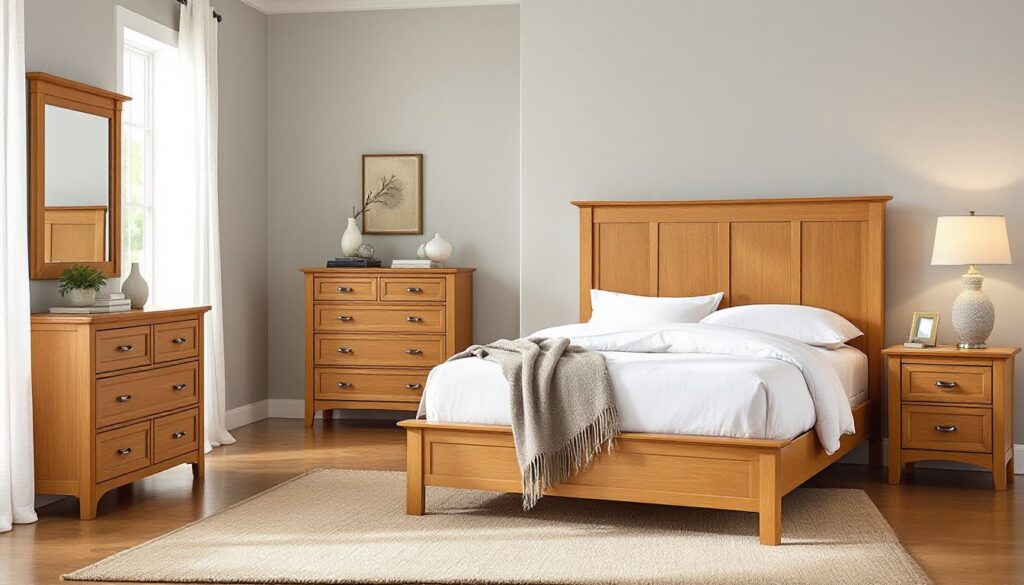
The Broyhill Fontana collection tops most collectors’ lists. Recognizable by its medium oak finish, arched drawer fronts, and brass teardrop pulls, Fontana epitomizes ’80s Broyhill craftsmanship. Complete sets (bed, dresser, mirror, two nightstands, and chest) regularly command $800–$1,500 depending on condition.
Broyhill Emphasis featured cleaner lines with a pecan or medium oak finish and rectangular brass hardware. The slightly more modern profile makes it easier to integrate into contemporary spaces. Individual dressers typically sell for $200–$400.
Broyhill Brasilia, though introduced in the 1960s, saw continued production into the early ’80s. Its mid-century modern aesthetic, characterized by sculpted drawer fronts, tapered legs, and walnut finishes, makes it the most valuable Broyhill line from any era, with desks alone fetching $600+.
Other notable lines include Broyhill Attic Heirlooms (traditional styling with distressed finishes), Broyhill Ming (Asian-inspired details), and Broyhill Chapter One (Colonial Revival influences). Each collection used consistent hardware, finish formulas, and construction techniques that make authentication straightforward once someone knows what to look for.
How to Restore and Refinish Vintage Broyhill Bedroom Furniture
Before stripping anything, assess whether the piece needs full refinishing or just cleaning and repair. Many ’80s Broyhill finishes were catalyzed lacquer, durable coatings that clean up remarkably well with 0000 steel wool and mineral spirits. Test an inconspicuous spot first: if the finish softens or dissolves, it’s likely shellac or straight lacquer that will need professional attention or complete removal.
For pieces requiring refinishing, proper stripping is critical. Use a methylene chloride-based stripper (brands like Citristrip work but take longer) in a well-ventilated area or outdoors. Wear nitrile gloves, safety goggles, and a respirator rated for organic vapors, not a dust mask. Apply stripper with a cheap chip brush, let it work for 15–30 minutes, then scrape with a plastic putty knife to avoid gouging veneer. Broyhill’s veneers are thick enough to handle careful scraping, but err on the side of gentleness.
Once stripped, sand progressively with 120-grit, 150-grit, and 220-grit sandpaper. A random orbital sander speeds the process on flat surfaces, but hand-sand details and edges to avoid burn-through. Veneer gives no second chances, once through to the substrate, repairs become visible.
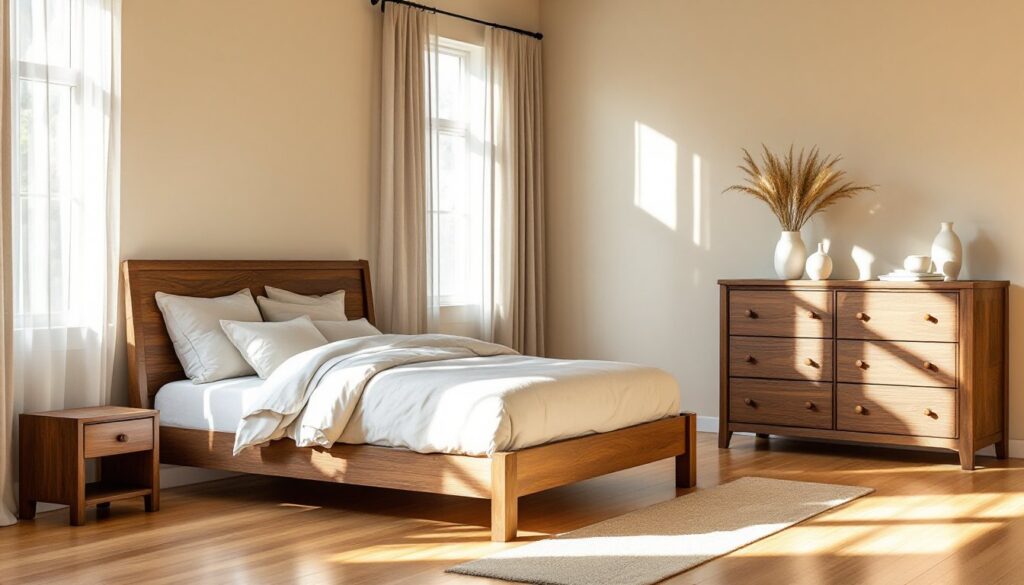
Stain selection changes the entire look. The original Broyhill oak finish was typically a medium golden oak achieved with Minwax Golden Oak or similar. For a modern update, consider Early American for a darker, richer tone, or skip stain entirely and go with a natural oil finish like Rubio Monocoat or Osmo PolyX for a Scandinavian vibe that highlights the wood grain.
Topcoat options depend on use. Water-based polyurethane (Varathane, General Finishes) offers low odor and fast dry times with good durability, apply three coats with 220-grit sanding between each. Oil-based polyurethane ambers slightly over time but provides superior scratch resistance for high-use surfaces like dresser tops. For a hand-rubbed look, paste wax over shellac delivers a traditional finish, though it requires more maintenance.
Hardware replacement makes a dramatic difference. Original brass pulls often have a lacquer coating that’s yellowed or flaked. Strip it with acetone, then polish with Brasso or leave it to develop a natural patina. Alternatively, swap for brushed nickel, matte black, or oil-rubbed bronze hardware, just fill old mounting holes with wood filler and drill new ones carefully to avoid splitting. Standard Broyhill pulls used 3-inch or 3-3/4-inch center-to-center spacing, so measure before ordering replacements.
Drawer repair is common. If glides are worn, Knape & Vogt center-mount drawer slides are affordable retrofits that match the original function. For sticky drawers, rub drawer edges and runners with a paraffin wax block (the kind used for canning), it’s slicker than soap and won’t attract dust.
Styling 1980’s Broyhill Furniture in Modern Bedrooms
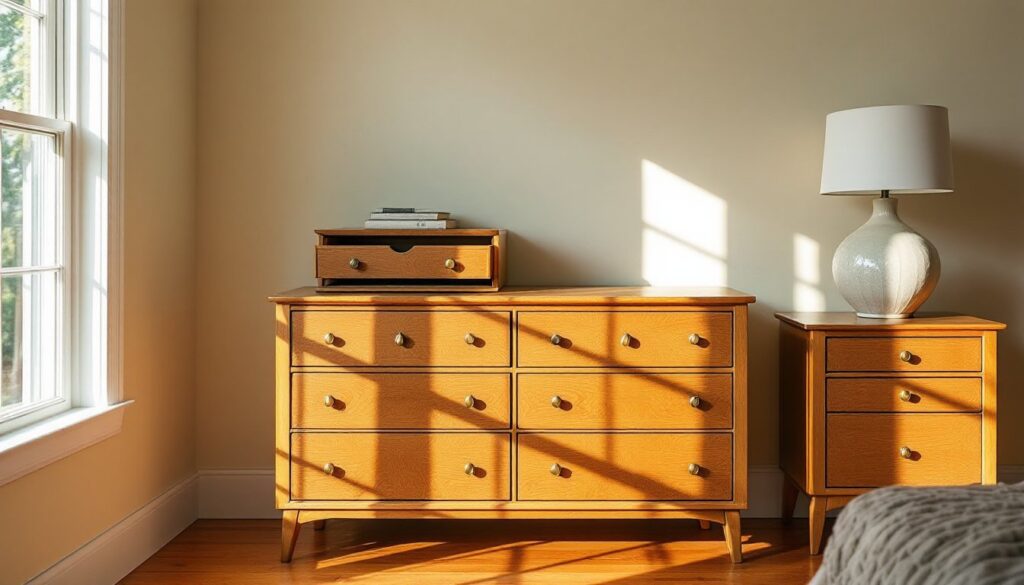
The key to integrating vintage Broyhill into contemporary spaces is contrast, not camouflage. A refinished oak dresser becomes a statement piece when paired with crisp white or gray walls instead of trying to match it with more wood tones. The mass and visual weight of a solid Broyhill triple dresser anchors a room in ways lightweight modern furniture can’t.
Hardware updates bridge eras. Swapping original brass pulls for sleek bar pulls in matte black or leather pulls gives instant modern relevance while preserving the piece’s proportions and joinery. For a softer update, ceramic knobs in neutral tones or brass cup pulls nod to the original aesthetic without looking dated.
Textile choices matter. Dress a Broyhill bed frame with linen bedding in neutral tones, oatmeal, charcoal, or soft white, to let the wood become a warm accent rather than a dominant theme. Avoid matching wood tones exactly: a walnut-finished nightstand next to an oak dresser creates intentional layering that reads as curated.
Lighting and art provide balance. A modern table lamp with a simple drum shade on a vintage Broyhill nightstand creates visual tension that feels deliberate. Hang large-scale abstract art or black-and-white photography above a dresser to pull focus upward and prevent the piece from reading as heavy or squat.
Mixing furniture styles prevents a time-capsule effect. Pair a restored Broyhill dresser with a metal bed frame or upholstered platform bed instead of the matching Broyhill headboard. Add a modern bench or storage ottoman at the foot of the bed for functional contrast. The goal is a bedroom that feels collected over time, not purchased as a matching set.
Where to Find and What to Pay for 1980’s Broyhill Pieces
Estate sales offer the best hunting grounds, particularly in suburbs where original owners are downsizing. Arrive early, serious buyers line up before doors open. Prices at estate sales tend to be firm but fair, typically $150–$400 for a dresser, $75–$150 per nightstand, and $200–$500 for a complete bedroom set depending on condition and collection.
Facebook Marketplace and Craigslist require patience and quick responses. Sellers often underprice Broyhill pieces because they don’t recognize the quality, listing a solid oak dresser for $50–$100 when it’s worth three times that restored. Search terms like “oak bedroom furniture,” “vintage dresser,” or “solid wood nightstand” yield better results than searching “Broyhill” specifically, since many sellers don’t know the brand.
Thrift stores like Habitat for Humanity ReStores occasionally stock Broyhill pieces, usually priced by weight and size rather than brand. A triple dresser might be tagged at $75–$150, regardless of condition. Inspect carefully, thrift stores typically sell as-is with no returns.
Auction sites like Everything But The House and MaxSold feature estate liquidations with detailed photos and shipping options. Competition drives prices up, but it’s possible to score deals on less-popular collections. Factor in buyer’s premiums (typically 18–25%) and shipping (often $150–$300 for a dresser) when bidding.
Pricing depends heavily on finish condition and completeness. A dresser with intact original finish in excellent condition commands $300–$500. The same piece with water rings, veneer damage, or missing hardware drops to $75–$150. Complete bedroom sets in excellent condition can reach $1,200–$1,800, though they’re harder to move due to size and buyer commitment.
Negotiation works, especially for pieces needing work. Point out specific repairs required, “This needs new drawer glides and the veneer is lifting on this corner”, to justify a lower offer. Cash in hand and willingness to haul immediately often shave 20–30% off asking prices. For inspiration on DIY furniture restoration projects, many hobbyists document their refinishing processes with detailed steps and material lists.
Conclusion
Broyhill’s 1980s bedroom furniture represents the tail end of an era when mid-priced furniture still meant solid construction and repairable joinery. These pieces weren’t heirlooms when they were new, but time and changing manufacturing standards have made them worthy of preservation. With basic refinishing skills and an eye for proportion, a $200 estate sale dresser becomes a bedroom anchor that outlasts anything available at that price point today.